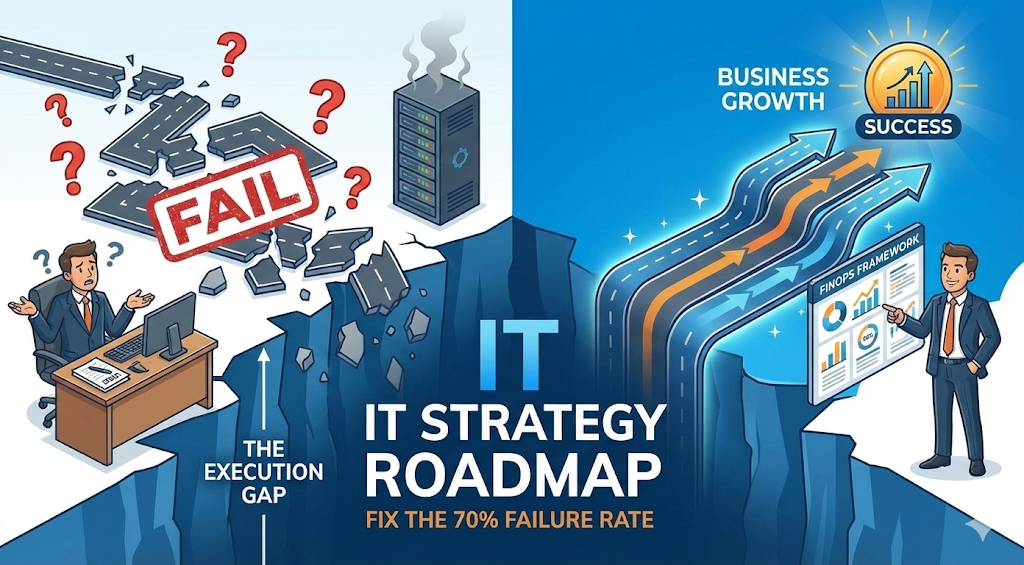
Let’s be honest. The IT strategy roadmap you’re about to spend the next quarter building has a shockingly high chance of failing. We’re not talking about minor delays or budget overruns. We’re talking about complete failure to deliver on strategic goals.
Don’t just take my word for it. Respected sources like McKinsey, BCG, and Gartner consistently report that a staggering 70-95% of large-scale strategic initiatives fail to achieve their intended results. Think about that. Up to 19 out of every 20 major IT transformations end up as expensive learning experiences rather than business game-changers.
Why? It’s not a lack of vision. It’s not a lack of technology. It’s an Execution Gap. The chasm between a beautiful PowerPoint presentation and a tangible business outcome is littered with the ghosts of failed projects—victims of stakeholder misalignment, fuzzy priorities, and a crippling lack of change management.
Most guides will give you a generic, five-step process for creating a roadmap. This isn’t one of them. This is a blueprint for building a roadmap that survives contact with reality. It’s a methodology designed specifically to counteract the reasons 70% of them fail, turning your IT department from a cost center into the engine of your business growth.
Table of Contents
- Phase 1: The brutally Honest Audit—Finding Your “As-Is”
- Phase 2: The Failure-Proof Prioritization Framework—Deciding Your “To-Be”
- Phase 3: From Priority List to Visual Roadmap—Visualizing the Plan
- Phase 4: Execution is Everything—Closing the 70% Implementation Gap
- Key Takeaways: Your Roadmap to a Better Roadmap
- Frequently Asked Questions
- Your Next Step Isn’t a Roadmap, It’s a Conversation
Phase 1: The Brutally Honest Audit—Finding Your “As-Is”
You can’t chart a course to a new destination without knowing exactly where you are. A shocking number of IT roadmaps are built on assumptions rather than facts. Vague business goals are a leading cause of failure, with one study showing 60% of initiatives suffer from the lack of an overarching master plan. Before you can dream about the “To-Be,” you have to get real about the “As-Is.”
This isn’t your standard SWOT analysis. We need to go deeper.
The IT/Business Alignment Checklist
Start by asking questions that bridge the gap between the server room and the boardroom. Sit down with department heads and the C-suite and get concrete answers:
Business Goal: “We want to increase market share by 15% in the Southeast region.”
IT Question: What specific technology (CRM enhancements, sales analytics tools, localized marketing automation) is required to support the sales and marketing teams in that effort? What data do they need that they don’t have now?
Business Goal: “We need to improve our operating margin by 5%.”
IT Question: Where are our biggest process inefficiencies? Can we automate manual data entry in finance? Can we optimize our supply chain with better inventory management software? Where does technology create friction instead of flow?
Business Goal: “We have to enhance our customer experience.”
IT Question: What’s our average support ticket response time? Can a chatbot handle Tier 1 requests? Do our customers have a seamless digital experience, or is our portal clunky and outdated?
This process forces you to translate abstract business objectives into tangible IT initiatives. The goal is to create a direct, unbreakable line of sight from every potential IT project back to a specific, measurable business outcome.
A Modern SWOT: AI Readiness and Technical Debt
A traditional SWOT is fine, but for an IT roadmap in 2025, it’s incomplete. You need to add two critical dimensions:
AI Readiness: The conversation has moved beyond “if” to “how.” Assess your organization’s readiness for pervasive AI. This isn’t just about buying a new tool. It’s about your data infrastructure, governance policies, and your team’s skills. Are your data sets clean and accessible, or are they siloed in legacy systems? Do you have an ethical AI usage policy? Answering these questions now puts you ahead of the curve.
Technical Debt: Every shortcut, outdated system, and postponed upgrade is a debt that accrues interest in the form of security vulnerabilities, poor performance, and integration nightmares. Quantify it. What’s the real cost of keeping that 10-year-old server running? How many man-hours are wasted on manual workarounds for a system that should have been replaced three years ago? Acknowledging this debt is the first step to allocating resources to pay it down.
Phase 2: The Failure-Proof Prioritization Framework—Deciding Your “To-Be”
Here’s where most roadmaps begin to die. You have a long list of great ideas from Phase 1. Now what? Most teams use gut feel, politics, or the “squeaky wheel” principle to decide what’s next. This is a recipe for disaster.
To get executive buy-in and ensure your roadmap delivers maximum value, you need a defensible, data-driven prioritization framework. Forget simple “High/Medium/Low” labels. You need a system that proves why a project is a priority.
Let’s use a Weighted Scoring Model. It’s transparent, collaborative, and forces you to justify your decisions with numbers, not just opinions.
Step 1: Define Your Strategic Criteria
These are the pillars that support your business goals. They should be agreed upon by both IT and business leadership. Keep it to 4-6 key criteria.
Strategic Alignment (Weight: 30%): How directly does this project support a primary business objective (e.g., increase market share, reduce operational costs)?
Potential ROI / Value (Weight: 30%): What is the expected financial return, cost savings, or efficiency gain?
Risk / Complexity (Weight: 20%): What is the likelihood of failure? How difficult is this to implement (technically, culturally)? Note: A higher risk gets a lower score.
User Impact / Adoption (Weight: 20%): How many users will this benefit, and how significant is the improvement to their daily work?
Step 2: Score Your Initiatives
Now, score each potential IT initiative (on a scale of 1-10) against each criterion.
Let’s take two common projects:
- A) New CRM Implementation: To support the “increase market share” goal.
- B) Upgrading Internal File Servers: To address technical debt.
| Initiative | Strategic Alignment (x0.3) | Potential ROI (x0.3) | Risk (Lower is Better) (x0.2) | User Impact (x0.2) | Total Score |
|---|---|---|---|---|---|
| A: New CRM | 9 (Directly supports sales) | 8 (High revenue potential) | 4 (High complexity/change mgt) | 9 (Impacts entire sales team) | (9×0.3)+(8×0.3)+(4×0.2)+(9×0.2) = 7.7 |
| B: Server Upgrade | 4 (Keeps lights on) | 5 (Prevents failure cost) | 8 (Low complexity) | 6 (Impacts everyone moderately) | (4×0.3)+(5×0.3)+(8×0.2)+(6×0.2) = 5.5 |
Step 3: Rank and Decide
Suddenly, the conversation changes. The New CRM (Score: 7.7) is a clear strategic priority over the Server Upgrade (Score: 5.5). When the CFO asks why you’re allocating a seven-figure budget to a new CRM, you don’t say, “The sales team really wants it.” You say, “According to our agreed-upon strategic criteria, this initiative scored highest on direct alignment with our market share goal and potential ROI. We’ve accounted for the risk, and it remains our top value-driver.”
This quantitative approach moves the discussion from opinion to objective analysis. It’s the single most powerful tool you have for securing buy-in and defending your budget.
Phase 3: From Priority List to Visual Roadmap—Visualizing the Plan
A prioritized list is not a roadmap. A roadmap tells a story. It translates your ranked initiatives into a visual narrative that shows where you’re going and how you’re going to get there.
The best roadmaps are thematic, not just a list of projects on a timeline. Group your prioritized initiatives into strategic themes that are easy for everyone to understand.
Theme 1: Customer Experience Transformation: This could include the new CRM project, a website chatbot implementation, and a customer portal refresh.
Theme 2: Operational Efficiency & Automation: This might contain the finance department’s automation project, a new inventory management system, and cloud migration for key applications.
Theme 3: Future-Proofing the Foundation: Here’s where you put that server upgrade, but also initiatives around cybersecurity enhancements and building an AI Governance Framework.
This thematic approach has several advantages:
It tells a better story: It’s easier for the CEO to grasp “We’re investing in customer experience” than to parse a list of 15 different software projects.
It provides flexibility: If a specific project within a theme gets delayed, the overall strategic goal of the theme remains intact. You can adapt without scrapping the entire roadmap.
It aligns with modern planning: It connects directly to frameworks like OKRs (Objectives and Key Results), where each theme is an “Objective.”
Now, plot these themes on a timeline (typically 12-18 months). Don’t get bogged down in exact dates. Use broad strokes: Quarters (Q1, Q2) or even phases (Now, Next, Later). The goal is to show direction, dependencies, and sequence, not to create a rigid project plan.
Phase 4: Execution is Everything—Closing the 70% Implementation Gap
You have an aligned, prioritized, and visualized roadmap. Congratulations, you’ve made it further than most. But now comes the hardest part: execution. This is where the 70% failure rate becomes a terrifying reality.
Remember, the biggest reasons for failure aren’t technical; they’re human. Inadequate change management is a leading cause of failure in 42% of ERP implementations alone. You can’t just deploy technology; you have to manage its adoption.
The Communication Cadence
Your roadmap is a living document, not a stone tablet. Set up a regular communication cadence.
Monthly Stakeholder Updates: A quick, one-page summary for department heads. What did we accomplish last month? What’s on track for this month? Where are the roadblocks?
Quarterly Executive Reviews: A formal review with the C-suite. Revisit the strategic goals. Show progress using your OKRs and KPIs. This is your chance to re-validate priorities and adjust the roadmap based on changing business conditions.
From KPIs to OKRs
Don’t just track project completion (KPIs). Track business outcomes (OKRs).
KPI: Launch new CRM by March 31st. (Did we do the thing?)
OKR: Increase sales lead conversion rate by 10% by the end of Q2. (Did the thing we did have the intended impact?)
Focusing on OKRs ensures that IT’s success is measured by the same yardstick as the rest of the business. It’s the ultimate proof of alignment.
Don’t Outsource Your Strategy
Building and managing a strategic IT roadmap is a complex, continuous process. It requires deep expertise not just in technology, but in business strategy, change management, and financial modeling. For many small and medium-sized businesses, this is where having a partner becomes critical. Effective managed IT services can provide the strategic oversight and technical expertise needed to ensure your roadmap not only gets built but gets executed successfully. A co-managed approach allows your internal team to focus on daily operations while we help you navigate the strategic complexities and avoid the pitfalls that cause 70% of initiatives to fail.
Key Takeaways: Your Roadmap to a Better Roadmap
Start with the “Why”: The 70-95% failure rate for strategic initiatives is real. Your primary job is to build a roadmap that survives execution by addressing the core failure points: misalignment, poor prioritization, and weak change management.
Diagnose Before You Prescribe: Conduct a brutally honest “As-Is” audit that directly links business goals to IT needs and includes modern factors like AI readiness and technical debt.
Prioritize with Data, Not Politics: Use a quantitative framework like a Weighted Scoring Model to create a defensible, objective project hierarchy that executives can understand and support.
Tell a Story with Themes: Group initiatives into strategic themes on your visual roadmap. This simplifies communication and builds flexibility into your plan.
Execute Relentlessly: A roadmap is useless without execution. Focus on proactive change management, a consistent communication cadence, and measuring business outcomes (OKRs), not just project outputs (KPIs).
Frequently Asked Questions
How often should we update our IT roadmap?
Your roadmap should be a living document. We recommend a formal review and update on a quarterly basis to align with business planning cycles. However, it should be flexible enough to adapt to major market shifts or internal business changes as they happen. Don’t be afraid to change course if the data tells you to.
How do we get buy-in from non-technical executives?
By speaking their language: value, risk, and ROI. The Weighted Scoring Model is your best friend here. Instead of talking about server specs, talk about how an initiative reduces operational risk. Instead of discussing software features, show how it directly enables a 15% increase in market share. Frame every IT investment in terms of a business outcome.
Our business priorities change constantly. How can a long-term roadmap work for us?
This is why a thematic, flexible roadmap is superior to a rigid, project-based timeline. Your themes—like “Improve Customer Experience”—will likely remain stable even if the specific projects within them change. By focusing on “Now, Next, Later” instead of specific dates, you build in agility. The goal is to have a strategic direction, not a tactical straightjacket. You’ll also need a process for handling incoming requests and scoring them against existing priorities to see if a shuffle is truly warranted.
What’s the difference between an IT strategy and an IT roadmap?
Think of it this way: The strategy is your destination—it’s the high-level vision of how technology will support the business’s overall goals over the next 3-5 years. The roadmap is your turn-by-turn navigation for the next 12-18 months. It’s the practical, actionable plan that shows what you’re doing, in what order, to make the strategy a reality. One can’t succeed without the other.
Your Next Step Isn’t a Roadmap, It’s a Conversation
Building a roadmap that actually delivers is one of the most challenging—and most valuable—things an IT leader can do. You don’t have to navigate the process alone.
If you’re ready to move beyond the cycle of failed initiatives and build an IT strategy that becomes a true competitive advantage, let’s talk. At DART Tech, we specialize in helping businesses like yours bridge the gap between vision and execution. We can facilitate the tough conversations, help you implement a robust prioritization framework, and provide the ongoing strategic guidance to keep your roadmap on track.
Contact us today for a complimentary IT Strategy Session, and let’s start building a roadmap that belongs in the successful 30%.